

The short answer: Choose a dense, hard block that does not wobble under your weight, in the standard 23cm × 15cm × 7.5cm size — and buy two, not one, if you practise more than once a week. Density matters more than colour: a harder block holds steady in standing and weight-bearing poses, while a softer block is lighter to carry but can compress when you lean on it. Everything below explains how to pick, how to use all three heights, and when a block is the wrong tool entirely.
A yoga block is not a beginner’s crutch. It is the prop that brings the floor up to you. Tight hamstrings, a long torso, stiff shoulders — a block closes the gap between your body and the mat so you can hold a pose with good alignment instead of straining toward a shape that is not there yet. Used well, it makes a practice safer and deeper. Used badly — wrong height, soft block under full weight — it wobbles, and wobble is what causes the fall.
One block, or two?
Start here, because it decides what you buy. One block is enough if you only ever need support on one side at a time — sitting tall in easy pose, or a single hand reaching down in a standing twist. Two blocks is the honest answer for most regular practitioners, because many poses need one on each side: triangle, half moon, wide-legged forward folds, seated folds, and lunges all ask for a block under each hand. If you practise more than once a week, buy two from the start — a single block bought twice costs the same and leaves you short in the meantime. And buy the pair together while your colour and design are in stock: a block design or colour can sell out, or never be restocked, and if you come back for the second one later you may not be able to get the same colour and design. If the second block doesn’t match, you end up having to buy another pair — and the odd block goes to waste. This is not a sales pitch; it happens often. If you are only trying yoga out, one block plus your mat is a fair first step.
Three heights in one block
A standard block is a rectangular brick, 23cm long, 15cm wide and 7.5cm thick, and that gives you three heights in one prop:
- Flat (7.5cm): the lowest lift — for seated poses, resting a hand lightly, or sliding under a hip in a gentle stretch.
- On its side (15cm): the middle height — the workhorse setting for triangle, standing forward folds and lunges, where you need real support but not the full height.
- Standing tall (23cm): the highest lift — for tight hamstrings and shoulders, or any pose where the floor still feels a long way down.
Most beginners only ever use the flat setting and wonder why the block does not help. Turn it. Try all three heights in the same pose and keep the one that lets you breathe easily and hold your alignment.

Material and density — what the numbers mean
Every block on Trillactive’s compare page shares the same footprint, so the choice is material and density, not size. The listed hardness ratings (HSC) describe firmness: a higher rating indicates a harder block. Compare the listed weights separately when portability matters.
- Minimalist — highly compressed EVA, 60 HSC, 550g. The densest block in the range, and the one included in the I’m Possible Bundle. Hard, steady, and it does not deform under full body weight — the right pick for standing poses, inversions and anyone who leans hard on their blocks. Contoured edges and an easy-grip surface stop it shooting out from under your hand. The trade-off is weight: it is the block you keep at home or at your regular studio, not the one you carry across town every day.
- Natural cork — 48 HSC, 750g. The heaviest block, with a warm, grippy natural feel. Cork grips better as it gets damp, which suits sweaty hands. It is solid and stable, but the heaviest to carry.
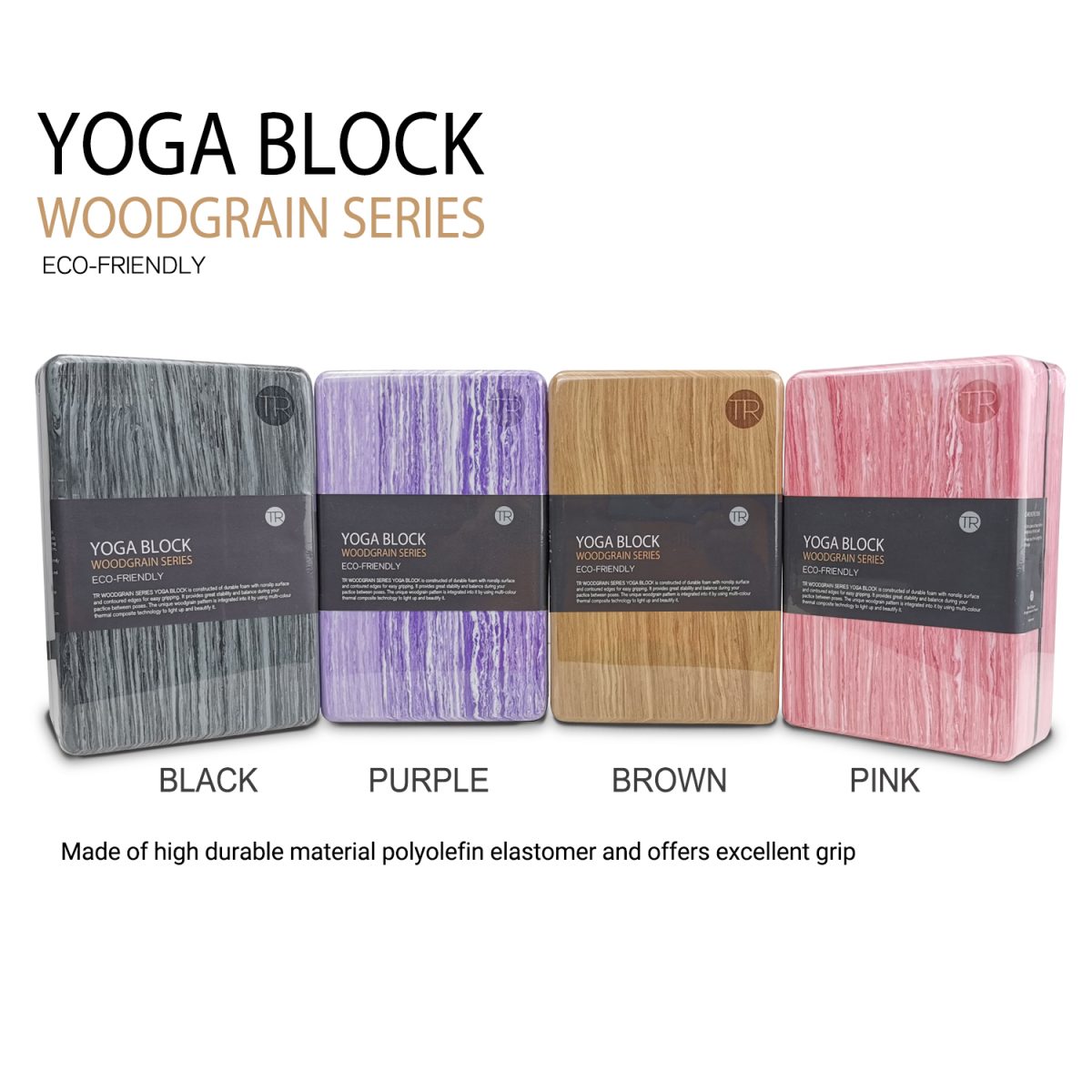
- Woodgrain — polyolefin elastomer, 45 HSC, 430–470g. A middle-density block with a wood-look finish. Lighter than cork and the Minimalist, still firm enough for most standing work.
- Rainbow — premium TPE, 42 HSC, 330g. The softest block in the range, and the lightest by listed weight (330g) — the High Density EVA block is the lightest overall (see the Ballet section; no gram weight is listed for it on the live site). Easy to carry and gentle under knees and elbows, but the softest under load — better for seated and restorative work than for full weight-bearing poses.
The rule of thumb: if the block will take your body weight — standing poses, lunges, arm balances — go denser (48 HSC and up). If it will mostly cushion and lift — seated poses, gentle stretches, travel — lighter is fine, and your shoulders will thank you on the commute.



Which poses actually need a block?
- Triangle (Trikonasana) and Half Moon (Ardha Chandrasana): a block under the lower hand, one on each side across the two poses, keeps the chest open instead of collapsing toward the floor.
- Standing forward fold and lunges: blocks under both hands bring the floor up, so the spine stays long instead of rounding.
- Seated forward folds: a block under each hand, or one to sit on, lifts the hips and lets tight hamstrings ease without forcing.
- Supported bridge and restorative poses: a block under the sacrum (flat setting) gives a gentle lift you can rest into for minutes.
- Sitting tall: sitting on a block in easy pose or hero pose tilts the pelvis forward and takes the ache out of the lower back — the single most useful block trick for beginners and anyone with tight hips.
If a pose feels like a strain rather than a stretch, add a block and raise the height. If it feels easy and your alignment holds, take the block away. The block is a tool, not a permanent fixture.
Ballet: one block, two hands
Ballet dancers use yoga blocks too. Here’s how it works in a beginner ballet class: one block, two hands on it, right in the middle. The whole point is getting both hands to travel at the same height, in the same sequence. With both hands on the same block, there’s nowhere to hide — if one hand creeps up or starts early, the block tips, and the dancer feels it straight away.
For this use, the block must be a light one — ballet beginners are mostly children, and a heavy block is too much for small hands to hold overhead and move with control. The lightest block in the range is the High Density EVA block: the product page describes it as ultra lightweight, with rounded edges for a comfortable grip. A gram weight is not currently listed. Trillactive identifies it as the lightest block in the range.
Start with the block at chest height, both hands resting on top, and move through the arm sequence slowly, keeping both hands level on the block. The block is the teacher here: it does not matter how it looks, it matters that both hands arrive together, every time.
Who else uses blocks?
Most blocks get bought for yoga. Plenty of them end up working a second job. Anywhere someone needs something firm, light and exactly the same height every time, a block turns up:
- Gymnastics: young gymnasts stand on them for cartwheel drills — the block teaches them to put their weight through their arms properly — and use them for balance routines and over-splits too.
- Pilates: they’re part of core work, planks, roll-ups and anything balance-related. Teachers also slip one under the reformer footbar for clients after a knee replacement, so the joint doesn’t take more load than it should.
- Physiotherapy and rehab: physios reach for them after surgery — for flexibility work and rebuilding range of motion, for grip strength, for supported bridges and for shoulder mobility drills.
- Barre: barre sits between ballet and Pilates, so it borrows from both — blocks included.
- Strength training and fitness: in the gym, heels go up on a block for a deeper squat, a block between the knees fires up a glute bridge, and push-ups off a block give you more range.
- Prenatal and seniors: before and after birth, and for older practitioners, it’s supported positions, balance work and sitting tall.
So if you’ve already got blocks for yoga, they’re not single-use. They’ll earn their keep well past the mat.
Blocks vs bolsters vs straps — the right tool for the job
These three props look interchangeable. They are not.
- A block lifts and supports. It is hard, precise and height-adjustable. Use it when you need the floor closer, or a firm platform to press into.
- A bolster cushions and opens. It is a large, soft cushion for reclined and seated poses — under the knees in savasana, under the spine in a supported backbend, under the hips in easy pose. It relaxes the body into a shape; it does not hold you up in a standing pose. A block cannot replace a bolster for restorative work, and a bolster cannot replace a block for standing work.
- A strap extends reach. It is a loop of fabric that lengthens your arms — around the feet in a seated forward fold, around the hands in cow-face pose, or holding the legs in a reclined hamstring stretch. Use it when your hands cannot yet meet; do not use a block for that job.
Trillactive’s prop range centres on blocks — the compare page above lists the full block range — plus the suede mat bag that comes in the bundle. If you practise yin or restorative yoga regularly, a bolster from a general yoga supplier can complement your blocks.
Pairing blocks with your mat
A block only works if the mat underneath it stays put. A grippy mat anchors the block as surely as it anchors your feet — a block sliding on a smooth mat is worse than no block at all. That is why the mat guide and this guide belong together: choose a mat that grips when wet, then add blocks that hold steady on it. For the material deep dive, read TPE vs Natural Rubber Yoga Mats: Which Is Right for Your Practice?
The simplest way to buy the set is to pair the Natural Rubber Luxe mat (the I’m Possible mat; 185cm × 68cm × 5mm, frosted PU over natural rubber) with the Minimalist block. If you already own a mat, the compare page at Yoga Blocks in Singapore: Compare Materials & Sizes is the place to pick your blocks. Prices live on the product and compare pages — check there on the day you buy, as sale prices change.

Care and storage — the Singapore way
Wipe blocks with a damp soft cloth after use, especially in this climate — sweat and humidity left on a block dulls its grip and, for cork, can mark the surface. Let them dry fully before stacking or putting them away, store them out of direct sun and away from heat, and do not stack heavy things on top of softer blocks or they will deform over time. In a small flat, two blocks stack neatly beside the rolled mat; in a studio bag, the lighter blocks travel better. A block that is clean, dry and stored flat will last years.
Frequently asked questions
Do beginners really need yoga blocks?
Yes — arguably beginners need them most. Blocks let you hold correct alignment while flexibility builds, instead of straining into a shape. They are not a sign of weakness; they are how good alignment is learned.
How many yoga blocks do I need — one or two?
One is enough to try yoga out. Two is the right buy if you practise more than once a week, because triangle, half moon, lunges and seated folds all use one block on each side.
Cork or EVA — which is better?
Neither is better in general; they suit different needs. Cork is heavier, grippy when damp, and very stable. High-density EVA (the Minimalist, 60 HSC) is the steadiest under full body weight and the one in the bundle. The High Density EVA block and the Rainbow TPE block are lighter and easier to carry, and gentler under knees. Choose on density first, material second.
Can I use books or a stack of cushions instead?
For a single seated pose, a firm cushion works. For standing and weight-bearing poses, no — books slide, cushions compress unevenly, and both are the wrong height. A block’s three fixed heights and non-slip surface are the point.
How do I clean a yoga block?
Wipe with a damp soft cloth or yoga mat cleaner after use, let it dry fully before storing, and keep it out of direct sun. Do not machine wash or soak a block — for cork especially, soaking damages the surface.
Ready to set up? Start with the Natural Rubber Luxe mat and a pair of blocks from the compare page — or come and test the mat and blocks first at the Ubi Techpark showroom, 10 Ubi Crescent, #01-19, Singapore 408564, Monday to Friday, 9am–4:30pm. Feeling is believing.